Tampilkan postingan dengan label food. Tampilkan semua postingan

Sabtu, 20 April 2013

How BikeCaffe's Mike Ash Sells Lattes From A Bike

Site of the day - PickyDomains.com, world's first risk free naming service 

http://bikecaffe.com

Mike Ash, who had worked in restaurants since he was 15 and earned a degree in hospitality management, hoped to one day open his own eatery. But as the years went on and he managed various restaurants and cafeterias, Ash, now 35, figured he was unlikely to ever save enough money to open his own place.

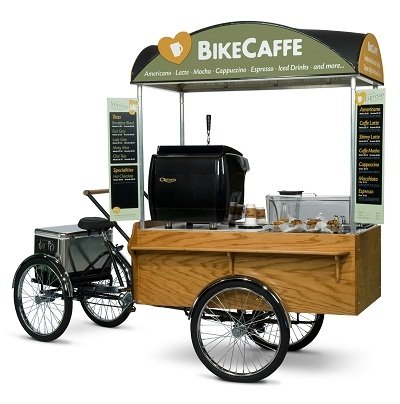
Then, flipping through a Costco circular in 2010, he saw an ad for the BikeCaffe, a British franchise concept that had recently come to the U.S. The idea was as simple as the name--a mobile coffee shop mounted on a four-wheel cycle, complete with Astoria espresso machine, blender, pastry bin, refrigerator and sink.

Ash signed on as one of the first U.S. franchisees and began fueling up downtown St. Petersburg, Fla. Today you can find him on the corner of Fourth Street and Central Avenue--or sometimes, especially if it's extra hot or rainy, inside the BB&T bank building. On weekends Ash sets up his mobile java machine at festivals and events.

Eventually, Ash hopes to step back from the grinder. "I would love to own multiple carts and spend my time marketing them," he says. "But until then, I still enjoy it. It's a pretty awesome job."

He filled us in on what it's like to be the go-to guy for to-go coffee in downtown St. Pete.

Coffee from a bike?

That can't be very good. The coffee is really, really good! It's all fair-trade organic tea and coffee, and I think we're the only place in downtown St. Pete that carries that. The biggest comment I get is, "You can't make all that stuff on your bike, can you?" Our menu is the same size as Starbucks'; we can make macchiatos, lattes, chai--everything. We also make smoothies.

All the drinks are made to order. It's a little slower than pouring drip coffee, but the quality is 10 times better.

How do you like making your own schedule?

It's kind of weird to start a business thinking you can work your own hours. But you end up working the same number of hours as before, usually more. At the same time, it's kind of cool that it's yours, and what you put into it, you get out of it. I'm always working. I get here at 6:20 a.m. to set up and leave around 4:30 p.m. I also work weekends, so at least 50 hours a week. In 16 months, I've missed only three days.

What's your biggest seller?

Lattes are always popular. People also like my seasonal drinks. I have a chalkboard and carry three or four specials per day. I usually create them myself, things like eggnog lattes, mocha peppermint hot chocolate or caramel toffee nut lattes. We have a lot of freedom to experiment.

Do you get a good workout riding the bike?

Well, the thing weighs about 400 pounds. I don't think I've ever ridden it more than half a mile at a time. It's geared super low, so if there are no hills or rough terrain, it's easy. You wouldn't win any races on it. Florida is pretty flat, so I'm lucky with that.

What's the biggest misconception about your BikeCaffe?

People assume I sell hot dogs. Every day someone comes up asking for one.

[Via - Entrepreneur.com]

Beyond Facebook – Twenty Some Social Tools Your Business Should Be Using

Will Social Intranet Gobble Up CRM? Yes, And It’s Only A Matter Of Time

Duda Mobile Takes On iOS And Android

PickyDomains - startup that caught everyone by surprise

From 0 To $30,000 A Month With Dropshipping

Off the Books: The Underground Economy of the Urban Poor

How TribeHR Turned Simple Idea Into Millions

Selasa, 02 April 2013

Tasty Startups - ChefdUp.com

Site of the day - PickyDomains.com, world's first risk free naming agency

http://chefdup.com/

A private, unique and memorable dining experience for your guests at your next dinner party doesn’t have to mean booking a reservation at an upscale restaurant or finding somebody good enough to cook for a crowd (if a group of eight to twelve can be considered a crowd). And that’s thanks to Chef’d Up, a startup founded by three Harvard guys: David Snider, John Feeney and David Werry.

With Chef’d Up, you get to bring home premier chefs in the Boston area that include Danya Bader-Natal, a former Clio chef, Katie Barry, former Rialto chef and currently with Lumiere, and Jitti Chaithiraphant, formerly with Radius and Lumiere and now with Franklin CafĂ© South End. Chef’d Up has a total of 10 chefs in its roster at the moment.

To book a chef for your event, first, browse through the chef’s profiles, including reviews from previous guests who have experienced receiving the chefs in their homes. Once you’ve selected a chef, you’re ready to provide the initial details of your event on a request form. Your chef will then contact you to discuss the event, the menu and the event price. Once the details are in place, your chef will confirm the agreed-upon event price in the Chef’d Up system, and you finalize the booking by paying via the site prior to the scheduled event.

On the day of the event, your chef will acquire the ingredients, prepare the meals in your kitchen, even clean up if you wish, allowing you to concentrate on hosting.

Chef’d Up, according to co-founder Snider, is a unique way to make high-end dining accessible to a larger part of the population.

Except for a $5,000 award from Harvard Business School’s FIELD program, Chef’d Up is mostly bootstrapped. The company makes money by receiving a portion of the fee paid to book a chef.

[Via - NicheGeek.com]

Bitrix24 gives away free cloud-based social intranet to startups

Student Startups - BestParking.com

Duda Mobile Takes On iOS And Android

PickyDomains - startup that caught everyone by surprise

From 0 To $30,000 A Month With Dropshipping

Off the Books: The Underground Economy of the Urban Poor

DoNanza - Freelance Startup That Broke All Rules

How TribeHR Turned Simple Idea Into Millions

5 Yammer Alternatives That Are Actually Better Than Yammer Itself

Hot Tips - The Best Free Business Tool You (Probably) Don't Know About.

Selasa, 31 Juli 2012

FoodBiz - MobiMunch.com

Daily Advice Link - How I Increased Sales 350% With Press-Release


http://www.mobimunch.com/

Food trucks are here to stay, and nowhere was this more evident than at an Off the Grid event last spring in San Francisco. The 35 trucks, tents and carts that made it through the application process took over Fort Mason Center's parking lot one nippy Friday evening, dishing out steadily dwindling supplies of empanadas, kalbi and mango-sticky-rice popsicles to a ravenous crowd.

In the midst of the aromatic chaos sat the Chairman, a Zagat-rated truck famous for its pork-belly Chinese bao (steamed buns). It was the first of dozens of trucks developed by Mobi Munch. Founded in 2009, Mobi Munch aimed to streamline the mobile food industry with a turnkey platform that standardizes every part of the operation--from vehicles and food sources to securing permits and negotiating with event promoters and office parks.

The goal, according to CEO Josh Tang, is to make every chef and restaurant owner feel they need a truck, just as they do a website. "Trucks are the one sector of the food-service industry that's still growing, and until now, there's been no regulation, and a lot of missed opportunities," he says, speaking from his downtown Los Angeles offices.

The Mobi revolution began with customized trucks, rebuilt by a manufacturing partner from the chassis up with features such as next-generation cloud-based POS systems and onboard generators. The low-mileage, late-model trucks are crash-test and sanitation certified, then leased out for as little as a year. If a chef strikes gold with a menu, Mobi can scale quickly, rolling out a fleet in two weeks.

The company recently launched MobileCravings.com, a nationwide food-truck private-lot booking system, to help its customers secure locations for their rigs. Tang is even looking into new engine technology to help power onboard kitchens more efficiently.

In the last three years, Mobi Munch has grown to 20 employees, scored a round of $7.8 million in funding and signed on pilot corporate clients such as Red Robin and Rubios, along with food-service companies like Aramark and Centerplate.

"We're not thinking linear growth," Tang says, stressing that Mobi's services not only help independent young chefs build a brand with lower risk, but also enable veteran restaurateurs to test new neighborhoods at a fraction of the cost of a commercial lease or advertising campaign. The end result is that consumers can try out more creative menus at a lower price. Who doesn't have an appetite for that?

[Via - Entrepreneur]

Kindle Fire Giveaway

Weird Jobs - Danger Artist

Lifehacks - Convert Reward Points On Your Card To Dollars In Your PayPal Account

Off the Books: The Underground Economy of the Urban Poor

PickyDomains - startup that caught everyone by surprise

The Coolest Facebook Business Tool You Probably Never Heard About

The (Evergrowing) List Of Cool Bootstrapping Sites

From 0 To $30,000 A Month With Dropshipping

My Name Is Beer, Mr.Beer

Daily Advice Link - Free Logo Service

Minggu, 06 Mei 2012

From Police Work To Sauerkraut

Daily advice link - Freelancer? We are hiring!


http://willsvalley.com/

Tom forrest, owner of Wills Valley & Forrest Acre Farm in Lancaster, maintains that sauerkraut, done right, doesn’t need refrigeration or a warehouse. “There’s not a whole lot of equipment that we use,” he explains of Wills Valley, his minimalist organic vegetable fermentation production. “We’re taking [the product] right out of the crock, putting it in a jar and putting a lid on it.”

Raw food fermentation, the art of processing using microorganisms, preserves fresh vegetables, dairy, and dried meats by enabling healthful bacterial strands and yeasts to break down food in the absence of oxygen. This process alters flavor and texture while increasing the available nutrient content. The aging process can take weeks – in some cases months – giving craft foods like cheeses, beer and chocolate distinct and subtle flavors.

Forrest ferments vegetables the traditional Pennsylvania Dutch way, with 52 original stoneware crocks, each holding up to 65 pounds of vegetables. The farm workers pack the produce weekly with sea salt and water, sourcing certified organic vegetables by the truckload from small organic farms, mostly within the immediate region. In addition to kraut, Wills Valley makes salty, sour, and slightly sweet pickled beets, kimchee and ginger carrots.

Forrest, a former policeman, quit the force in 2000 at the age of 30 to start his first farm in Salem, N.J. He bought Wills Valley from Tim Bock, a Pennsylvania Dutch farmer and retired engineer, whom he had met at a farmers market. Bock, who began work at the farm by making sauerkraut from a family recipe, was ready to retire.

Acquiring an old-fashioned fermentation practice proved to be a solid business move, but also spoke to Forrest on a gut level. The traditional fermenting method is, in all likelihood, older than fire and is practiced by most native cultures. In recent years, fermentation has been popularized by food activists, including Sally Fallon (Nourishing Traditions) and Sandor Katz (Wild Fermentation and The Revolution Will Not Be Microwaved).

Forrest, an avid follower of Fallon and professional acquaintance of Katz, believes in traditional methods of processing foods, which do not include preservatives, stabilizers or refrigeration. When he brought the Wills Valley product to the Kutztown market, he found older patrons were nostalgic, recalling kraut-making as their first job. With current culture putting more focus on avoiding frozen and commercially-processed foods of the post-World War II era, Forrest sees his products playing an important role in both our culinary history and future.

[Via - GridPhilly]

From Making Sushi In A Home Kitchen To Sushi Empire - Philip Maung Story (HisshoSushi.Com)

How I Turned Hobby Into A Thriving Crowdsourcing Business. Part 3

Estimize.Com Bets That Crowds Are Smarter Than Wallstreet Analysts.

Bootstrapping 101: Tips to Build Your business with Limited Cash and Free Outside Help

From 0 To $30,000 A Month With Dropshipping

New Startup Pays Experts To Answer Questions

The Lean Startup: How Today's Entrepreneurs Use Continuous Innovation to Create Radically Successful Businesses

Does your site need hits? We've got them!

Sabtu, 05 Mei 2012

From Making Sushi In A Home Kitchen To Sushi Empire - Philip Maung Story (HisshoSushi.Com)

Daily advice link - Freelancer? We are hiring!


http://www.hisshosushi.com/

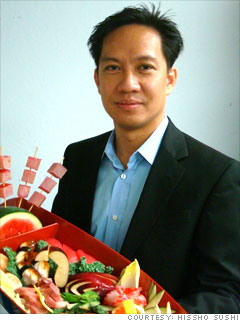
When Philip Maung began a sushi-making company on his dining room table 14 years ago, a 46,000-square-foot headquarters with ping-pong tables, spontaneous karaoke sing-a-longs and smiling employees seemed like a distant dream. Yet, over the last decade and amid a struggling economy, Maung has built his business into a vibrant food service distribution company that currently manages over 400 sushi bars in high-end grocery stores, cafes, hospitals and universities throughout the United States.

A true embodiment of the American dream (he came to the U.S. in 1989 with $13), Maung saw a business opportunity in a practically destitute sushi market on the east coast. He chose Charlotte as the company's base because of the number of banks the city had, but quickly learned they were hesitant to give him a loan without previous successes. Pooling resources with his wife, Maung says Hissho started with many sleepless nights.

Quality product and detailed service was what brought Hissho early success, allowing it to snowball into the franchise it is today. Hissho boasts 62% 3-year growth in an economic decline.

"We don't advertise," Muang explains, "People call us. Our business was built through word of mouth. Our success came because we built relationships with one partner at a time and we stand behind our product."

Muang likens Hissho to Starbucks, calling his sushi an "affordable luxury." The product is also in areas people who are no longer eating out usually tend to go: the supermarket.

Hissho's mission to produce the highest quality sushi with the best ingredients starts at its hub in Charlotte. All of Hissho's chefs spend seven to 11 weeks training at the company's headquarters before relocating to a Hissho sushi bar in affiliated market places.

Despite his company's dominance of the supermarket sushi culture (reporting $34.6 million in revenue for 2010) and an invitation last fall to hear President Obama speak to Congress, Maung is happiest about his company's recent internal transformation.

"The first 10 years we didn't have a company culture at all," Maung says. "We worked so hard. I began to realize that money wasn't everything and our people were tired. We've created a second home for our employees and we make sure they have fun. Nothing is going to happen if you don't take care of your people."

[Via - Unusual Business Ideas]

How I Turned Hobby Into A Thriving Crowdsourcing Business. Part 3

Estimize.Com Bets That Crowds Are Smarter Than Wallstreet Analysts.

Bootstrapping 101: Tips to Build Your business with Limited Cash and Free Outside Help

How Does eWorky Work?

From 0 To $30,000 A Month With Dropshipping

New Startup Pays Experts To Answer Questions

The Lean Startup: How Today's Entrepreneurs Use Continuous Innovation to Create Radically Successful Businesses

Need Perfect Software Name? Try Crowdsourcing.

Minggu, 15 April 2012

Baseball Cookies A Homerun

Idea Spotlight - New Startup Pays Experts To Answer Questions


http://www.cooperstowncookie.com/

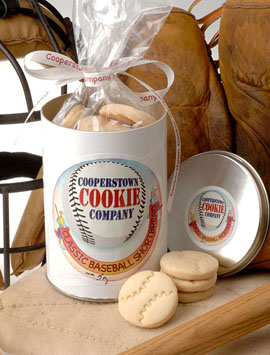
Cracker Jack, peanuts, hot dogs. It almost seems like ballpark food is more exciting than the game itself. And if Pati Grady has anything to do with it, we'll soon be adding shortbread cookies to the list of iconic ballpark snacks.

In 2004, Grady searched online for a baseball cookie cutter to no avail. Improvising, she used a drinking glass to cut rounds out of dough made from her family's shortbread recipe and used a crimping tool to make stitches.

Coincidentally, the cookies were the exact size of MLB regulation baseballs, and Grady sensed that she had the seed for a new business. She incorporated and named the company Cooperstown Cookie, in honor of her hometown and the location of the National Baseball Hall of Fame and Museum.

In 2008, Cooperstown Cookie scored official licenses with Major League Baseball and the Hall of Fame, doubling sales immediately. "It changed everything," Grady said. "And with licenses, the world of wholesale opened up."

Today, she supplies her treats to stadiums across the country, from Busch Stadium in St. Louis to Seattle's Safeco Field. Grady also does a pretty brisk online business, selling cookies packaged in boxes and teams emblazoned with team logos.

[Via - CNNMoney]

SafetyTats.com Story

How to Make Millions with Your Ideas: An Entrepreneur’s Guide

Crazy Startups - Hangover Bus

How To Sell A Dog For $230,000

From 0 To $30,000 A Month With Dropshipping

Up and down (and up and down) with Baltimore County internet-porn pioneers Jen and Dave

Company Name Ideas

Daily advice link - Designer? We Are Hiring!

Rabu, 21 Maret 2012

Catering To Startups - ZeroCater Story

Things Called Books - Normal Gets You Nowhere


http://zerocater.com/

If you’re one of the growing number of startups in Silicon Valley area that gets regular deliveries of catered food, you’ve probably heard of ZeroCater. And if you haven’t yet, you should: The startup is quickly becoming the go-to place for handling all the logistics of ordering lunch (and other meals). With a flexible delivery schedule and a huge number of food vendors that it’s partnered with, it could be the easiest and most efficient way to make sure your office gets fed.

What I really love about ZeroCater, though, is the story: It’s all about one dude with some entrepreneurial drive that created a business by solving a problem for himself, then offering up a solution to others.

ZeroCater founder and CEO Arram Sabeti moved to the Bay Area after becoming a bit obsessed with Paul Graham’s essays. Sabeti wanted to work in startups, so he saved up some cash, got a place in the East Bay and just started looking for work. He landed at Justin.tv, where he says he handled a lot of the office management, QA and all sorts of other things that no one else wanted to do.

While at Justin.tv he handled daily lunch orders for the startup, which was routinely the most problematic part of his job. From talking to other folks in similar positions, he found out he wasn’t alone — dealing with catering was a huge pain for everyone who handle such things. So he took on another startup client and began outsourcing his expertise to Justin.tv as well.

At first, ZeroCater was just Sabeti, a bunch of hustle, and a spreadsheet with about 500 columns in it. Then he brought on CTO Bill Moorier to build some code to automate some things. Like invoicing, for instance: Prior to getting a software platform in place for managing accounts, Sabeti was spending some 20 hours a week just filing invoices for various companies he worked with. With that simplified, the business began to operate a lot more smoothly and started to grow.

ZeroCater was part of last spring’s YCombinator class and raised $1.5 million last summer from investors like Keith Rabois, SV Angel, Start Fund, Stewart Alsop, Justin.tv founders Justin Kan and Emmett Shear, Alexander Goldstein and Starling Ventures. With financing in hand, it’s been aggressively expanding within the Bay Area: In the past eight months, ZeroCater has grown from three employees to 15, with six account managers and two salespeople now on board.

That’s translated into some real business, as ZeroCater is expanding beyond just word-of-mouth marketing and serving startups, and branching out into other verticals. It serves about 175 companies a month, offering a rotating menu from various caterers, restaurants and food trucks around San Francisco. Those companies range in size and in the volume of business they drive: Some are multinational corporations that you know and love, while others are startups you’ve never heard of; some order just a few meals a month, while others get food catered everyday. For taking care of all their catered food needs, ZeroCater charges just a 7 percent convenience fee on all orders.

On the vendor side, working with ZeroCater means regular business for a number of food service operators that otherwise would be reliant on the whims and fancy of the general public. In exchange for volume discounts, ZeroCater provides a steady stream of orders for a number of local businesses.

While ZeroCater has cut its teeth serving the Bay Area, Sabeti tells me he hopes to take this business worldwide. And there’s plenty of interest: ZeroCater has a waiting list of more than 165 companies in major metropolitan areas around the country. ZeroCater’s next market has yet to be determined, but it’s clear that the lunch problem is pretty universal, whether it’s a matter of feeding a 15-person startup or a large financial services company.

[Via - GigaOm]

The Professional Caterer's Handbook: How to Open and Operate a Financially Successful Catering Business

Freelancer? We are hiring!

Start Small, Stay Small: A Developer's Guide to Launching a Startup

And Where Is MrsBeer?

Cool Startups - DollarShaveClub.com

Mint.Com Success Story

Rabu, 14 Maret 2012

It's Not Just Beer, It's MrBeer.

Web 2.0 Names - A Sooper Smpl Xuide


http://MrBeer.com

“Not bad. In fact, my first home brew wasn’t as good as this.”

That was Garrett Oliver, Brewmaster of Brooklyn Brewery, and what he had to say when he gave a MrBeer beer kit a try for himself. And believe us—he wasn't drunk when he said that.

Oliver described the “Mr. Beer Process” in three steps: "We sanitize, we brew, and then we bottle."

And how much did it cost him to make a 2-gallon beer?

It took him $40 for the complete kit—and a 2-gallon beer worth $.25 cents to $1, depending on the size of the bottle that’s being used.

That's not bad, considering it tastes good. Comedian Andy Dick once had a test run of the Mr. Beer as well, and all he had to say was: "That's smooth. That's probably the smoothest beer I've ever drank." And unlike those that have been shipped and exposed to outside air, Mr. Beer’s aroma is more intense because it comes straight from the plastic beer keg.

Mr. Beer has been in the business of creating the world's easiest home brewing systems and supplies since 1993. They use barley, wheat, and hops for their malts, and are brewed on their modern facility on South Island NZ. They use a complex process of cracking, heating, and separating grains and then adding in hops to produce the color, balance, and flavor that beer is known for. However, the difference is that with Mr. Beer, all the excess water is removed, and the concentrated malt extract that’s left would be canned for shipping.

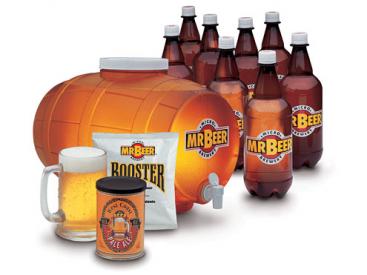
Their most popular product is the Premium Edition Mr. Beer Kit, which comes with a 2-Gallon Fermenter, first batch of beer (Standard Booster Recipe with Hopped Malt extract, dry brewing yeast, and No-Rinse Cleanser), eight amber-colored bottles with caps and labels. These bottles are designed to accommodate carbonated beverages, and are FDA approved.

Other Mr. Beer products also include Cider Kits a nd Root Beer kits—and they taste good as well.

With such high-tech procedures, does it guarantee perfect beer all the time?

Not necessarily. It depends on how you brew it.

"It's a little bit sweet and needs a little bit more carbonation." Oliver observed, after tasting his first batch of beer.

But here’s where he made a teeny-tiny-itsy-bit mistake: he didn’t wait long enough for the beer to ferment.

A good way to avoid this is to let the beer sit longer than a week to reduce its sweetness. The longer it ferments, the less sweet it becomes.

As with everything else, patience really IS a virtue when it comes to brewing your own beer. According to Drew Vics, a.k.a "The Brewologist", you can have home brewed beer in two weeks, but if you want it to taste its best, then wait for four weeks—or three and a half, if you can't wait any longer.

A good solution for that "le ss head" or "less carbonation" problem so often encountered by first-time brewers is to dissolve no more than 3/8 of a cup of sugar or confectioner's corn sugar into 1 pint of hot water and then let it cool. Then divide them evenly among your bottles instead of adding each sugar in each bottle (as what the direction says). This results in better and more even carbonation.

Really, it doesn’t get any simpler than that. Vics put it succinctly: "Mr. Beer makes a good beginner home brewing kit, and it is a great kit to keep around and reuse, even for the more advanced brewer. This is a great way to get your feet wet, and learn the basics of the home brewing process."

For Mr. Beer coupons, click here.

[Via - Odd News]

* - do you own a web-based business? We'd like to profile your business, too.

The Million-Dollar Idea in Everyone: Easy New Ways to Make Money from Your Interests, Insights, and Inventions

10+ Unusual Ways To Make Easy Money On The Internet If You Love Writing.

5 Coolest Beer Records

15 Most Common Myths And Misconceptions About Beer

101 Businesses You Can Start With Less Than One Thousand Dollars: For Stay-at-Home Moms & Dads

Make Your Ideas Mean Business

Link Of The Day - Product Naming

Jumat, 09 Maret 2012

Get Ready For Cupcake 'ATM'

Daily advice link - Freelancer? We are hiring!


http://www.sprinkles.com/

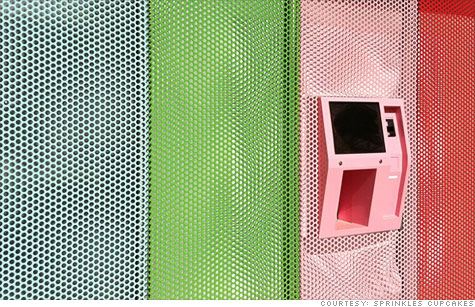
Get ready for an ATM where your dough comes out freshly baked -- with icing on top.

Sprinkles, a gourmet cupcake chain with 10 locations nationally, is set to open its first 24-hour cupcake vending machine on March 9 at its original store in Beverly Hills, Calif.

Company spokeswoman Nicole Schwartz says that there will be ten of the machines in operation by this summer, and even more by the end of the year.

At first, the Cupcake ATMs will all be within Sprinkles stores, but accessible from outside so that customers can indulge even when stores are closed.

Eventually, Schwartz said the machines will be at remote locations apart from the stores.

Sprinkles opened in 2005 and remains privately held. It has locations in Beverly Hills, Newport Beach, Palo Alto and La Jolla, California, as well as New York City, Chicago, Washington, D.C., Dallas, Houston, and Scottsdale, Ariz. The New York, Washington and Chicago locations are next in line for the cupcake ATM

The company had intended to call the machines 24-hour Sprinkles, but Schwartz said the name Cupcake ATM just kind of suggested itself.

There won't be an ATM fee per se, but cupcakes in the machine will cost $4, compared to $3.50 inside the store. The machines will only take credit or debit cards, no cash.

Schwartz said the selection in the machine will be rotated daily, although a few of the company's most popular selections, such as red velvet, will always be in the machine.

The machines will be able to hold 600 cupcakes at a time.

"It's going to be a lot bigger than a typical vending machine, let alone an ATM machine," she said.

[Via - CNN, Submitted by Domain Namer]

A Zombie Ate My Cupcake: 25 Deliciously Weird Cupcake Recipes

SocialEngine - Create Your Own Social Network

In Canada, repair shop helps customers service their own motorcycles

One Simple Idea: Turn Your Dreams into a Licensing Goldmine While Letting Others Do the Work

Starting A New Business? Get Free $50 For Your First PPC Campaign

How One Couple Turned From Teaching To Filling Ink Cartriges (And Made A Million Meanwhile)

Selasa, 13 Desember 2011

uFlavor.com

Site of the day - PickyDomains.com, world's first risk free naming agency


http://uflavor.com/

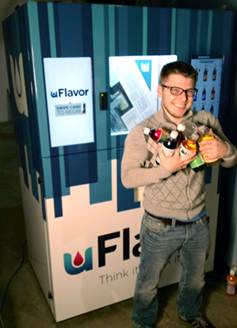
Mad scientists, rejoice: An Indianapolis startup is rolling out a make-your-own-soft-drink campaign its founders hope will become the YouTube of the beverage industry.

The idea is simple, even if the execution isn’t. Customers will be able to choose the ingredients for custom-made concoctions and design their own labels, then uFlavor will make and sell the drink—to its creators and the general public, who’ll be asked to rate the finished product.

“That level of mass customization is pretty intriguing,” said Jerry McColgin, founder of Carmel-based production and design firm Insight2 Inc. “Everyone wants something that is uniquely their own. They’re onto something there.”

Brown concurred.

“It’s one of the biggest trends out there right now,” he said. “There’s no reason uFlavor can’t be in the forefront of that."

McColgin, who has no connection to uFlavor, also praised the company’s slow-but-sure rollout strategy. Rather than immediately go to market with a product that’s new to consumers, many firms have had success generating buzz first.

“You want people waiting for it, watching for it,” he said. “But ultimately, your product has to live up to the expectations you create.”

Cloran and his partners have been working on uFlavor since 2009, when he pulled the concept out of his “ideas” folder. His original brainstorm came about 10 years ago: a vending machine that could produce any drink in the world.

“It was a crazy idea, too hard to build” said Cloran, 43.

Then he met Purdue University graduates Nathan Altman and Mike Mitchell, fellow entrepreneurs who met as members of Carmel High School’s award-winning robotics team. They thought they could pull it off, and they did.

A prototype was on display Thursday at DeveloperTown, which also invested in the project, but the partners decided it made more sense to build the online marketplace—and line up additional funding—before mass-producing the machines.

Home soda-making equipment already is sold at thousands of retailers. Market leader SodaStream, for example, allows users to choose their own syrup, bottle and carbonation. The partners say uFlavor breaks down the process even further.

“We really want to open up the ‘black box’ of the flavor industry—how different acids affect the tongue, how different tastes unfold,” Cloran said.

Cinnamon gives Coca-Cola its characteristic bite, for example, while Pepsi dials up the sweetener.

uFlavor’s founders worked with FONA to get a feel for how to blend flavors, and the company’s flavor scientists helped tweak the first three drinks to get them just right.

A single custom soda sells for $9.99 on uFlavor’s website, an eight-pack is $29.99 and a 24-pack is $59.99—all with free shipping within the continental United States. Once users start designing their own flavors, the company plans to use the Threadless model and give creators a share of the proceeds.

The partners hope to return to Indianapolis in two weeks with some sales in the books, which could help them line up additional funding. They declined to disclose financial details, but Verge CEO Matt Hunckler is chronicling the trip online.

“It’s always exciting in a startup environment when people pay you,” said Altman, uFlavor’s CEO and “prime minister of choice.” Mitchell is chief technology officer and “viceroy of variety.”

The men, both 24 and partners in DeveloperTown, will be working full time on uFlavor. Cloran, the chairman and “flavor emancipator,” will devote one day a week to the startup.

For more unusual ways to make money, visit this site.

[Via - NicheGeek.com]

* - do you own a web-based business? We'd like to profile your website, too.

Dude, What's Wrong With Your Head? How Head Injury Made One Man Rich

Matt Lauzon And His Success Story

How To Make Half A Million Dollars, Writing About Parking Lots

How to Make Millions with Your Ideas: An Entrepreneur's Guide by Dan S. Kennedy

101 Businesses You Can Start With Less Than One Thousand Dollars: For Stay-at-Home Moms & Dads

Make Your Ideas Mean Business

Site of the day - PickyDomains.com, world's first risk free naming agency

Sabtu, 03 Desember 2011

MrBeer Kit Review

Link Of The Day - Product Naming


http://MrBeer.com

“Not bad. In fact, my first home brew wasn’t as good as this.”

That was Garrett Oliver, Brewmaster of Brooklyn Brewery, and what he had to say when he gave a MrBeer beer kit a try for himself. And believe us—he wasn't drunk when he said that.

Oliver described the “Mr. Beer Process” in three steps: "We sanitize, we brew, and then we bottle."

And how much did it cost him to make a 2-gallon beer?

It took him $40 for the complete kit—and a 2-gallon beer worth $.25 cents to $1, depending on the size of the bottle that’s being used.

That's not bad, considering it tastes good. Comedian Andy Dick once had a test run of the Mr. Beer as well, and all he had to say was: "That's smooth. That's probably the smoothest beer I've ever drank." And unlike those that have been shipped and exposed to outside air, Mr. Beer’s aroma is more intense because it comes straight from the plastic beer keg.

Mr. Beer has been in the business of creating the world's easiest home brewing systems and supplies since 1993. They use barley, wheat, and hops for their malts, and are brewed on their modern facility on South Island NZ. They use a complex process of cracking, heating, and separating grains and then adding in hops to produce the color, balance, and flavor that beer is known for. However, the difference is that with Mr. Beer, all the excess water is removed, and the concentrated malt extract that’s left would be canned for shipping.

Their most popular product is the Premium Edition Mr. Beer Kit, which comes with a 2-Gallon Fermenter, first batch of beer (Standard Booster Recipe with Hopped Malt extract, dry brewing yeast, and No-Rinse Cleanser), eight amber-colored bottles with caps and labels. These bottles are designed to accommodate carbonated beverages, and are FDA approved.

Other Mr. Beer products also include Cider Kits a nd Root Beer kits—and they taste good as well.

With such high-tech procedures, does it guarantee perfect beer all the time?

Not necessarily. It depends on how you brew it.

"It's a little bit sweet and needs a little bit more carbonation." Oliver observed, after tasting his first batch of beer.

But here’s where he made a teeny-tiny-itsy-bit mistake: he didn’t wait long enough for the beer to ferment.

A good way to avoid this is to let the beer sit longer than a week to reduce its sweetness. The longer it ferments, the less sweet it becomes.

As with everything else, patience really IS a virtue when it comes to brewing your own beer. According to Drew Vics, a.k.a "The Brewologist", you can have home brewed beer in two weeks, but if you want it to taste its best, then wait for four weeks—or three and a half, if you can't wait any longer.

A good solution for that "le ss head" or "less carbonation" problem so often encountered by first-time brewers is to dissolve no more than 3/8 of a cup of sugar or confectioner's corn sugar into 1 pint of hot water and then let it cool. Then divide them evenly among your bottles instead of adding each sugar in each bottle (as what the direction says). This results in better and more even carbonation.

Really, it doesn’t get any simpler than that. Vics put it succinctly: "Mr. Beer makes a good beginner home brewing kit, and it is a great kit to keep around and reuse, even for the more advanced brewer. This is a great way to get your feet wet, and learn the basics of the home brewing process."

For Mr. Beer coupons, click here.

[Via - Offbeat News]

* - do you own a web-based business? We'd like to profile your business, too.

The Million-Dollar Idea in Everyone: Easy New Ways to Make Money from Your Interests, Insights, and Inventions

10+ Unusual Ways To Make Easy Money On The Internet If You Love Writing.

5 Coolest Beer Records

15 Most Common Myths And Misconceptions About Beer

101 Businesses You Can Start With Less Than One Thousand Dollars: For Stay-at-Home Moms & Dads

Make Your Ideas Mean Business

Link Of The Day - Product Naming

Senin, 21 November 2011

Jerkey Station

Idea of the day - PickyDomains.com, world's first risk free naming agency


http://www.caribreoso.com/JerkStation.html

Residents and workers in Redmond can get a taste of the Caribbean without leaving city limits.

The Jerk Sation, a mobile food truck serving up Caribbean cuisine, made its debut in Redmond on Monday and is helping owner and chef Michael Cunningham get his food out to hungry people.

The Renton resident and former Boeing employee opened for business about two weeks ago in Woodinville, where he is stationed in the parking lot of the Woodin Professional Building at 13901 NE 175th St. on Tuesdays and Fridays. Right now, Cunningham is in Redmond on Mondays and his truck is parked at 6855 176th Ave. N.E. The Jerk Station also parks in Renton on Wednesdays and Thursdays in the Center Cycle parking lot at 3950 Lind Ave. S.W.

"My preference is to stay on the Eastside," Cunningham said.

The Jerk Station offers food in two categories: Caribbean classics and Caribbean creations. The former features classic Caribbean dishes such as Jamaican patties, jerk meats, rice and peas and mofongo. With his creations, Cunningham said he has created original dishes that use Caribbean preparation techniques. Some of Cunningham's dishes include a Haitian lobster roll, Puerto Rican crab cake and Cubano cheesesteak.

Cunningham received his culinary training at the Kitchen Academy (now called Le Cordon Bleu College of Culinary Arts) in Tukwila and graduated in 2008. Although he grew up in the South, Cunningham went to school in south Florida, which introduced him to Caribbean food. This was one of the reasons he chose to focus on Caribbean cuisine.

"I always enjoyed the food," he said.

To promote his new business, Cunningham, who has a masters of business administration in marketing, said he did a lot of footwork by passing out flyers before he opened, but he has also utilized social media, promoting the Jerk Station on Twitter (his handle is @CaribreosoCater) and Facebook. Through Twitter, Cunningham said he is able to communicate directly with customers, giving them real-time information about what he's selling and even taking suggestions on what people want.

Cunningham added that since he began Jerk Station, his Twitter account — which he also uses to promote Caribreoso, his catering company — has tripled in the number of followers.

"It's been growing pretty quickly," he said, adding that posting pictures brings in more followers as well.

The idea to start a food truck came to Cunningham when he was laid off from Boeing in 2010. At that point, he had already put the wheels in motion to start a catering company, but he also wanted to offer a lunch service. Cunningham said he initially started with a delivery service, but that didn't work because orders weren't coming in with enough time for him to cook the food and get it to his customers.

Right around this time documentaries and shows about food trucks were airing and Cunningham saw that they were run by experienced, professional chefs.

"These are people who have extensive, well-established food backgrounds," he said.

A food truck seemed like the perfect idea for Cunningham. He said he didn't want to open a brick-and-mortar restaurant because the hours were too long and grueling. He said he wants to be able to spend time with his wife and a restaurant would have him working opposite hours as her.

Eventually, way down the line, Cunningham can see himself opening a bed and breakfast with a full-service restaurant, somewhere on the beach. But that's far into the future.

For now, Cunningham said he enjoys seeing people eat his food and interacting with his customers.

"I feed off of that," he said.

For more unusual ways to make money, visit this site.

[Via - Redmond Reporter]

* - do you own a web-based business? We'd like to profile your website, too.

The Million-Dollar Idea in Everyone: Easy New Ways to Make Money from Your Interests, Insights, and Inventions

10+ Unusual Ways To Make Easy Money On The Internet If You Love Writing.

IdeaSpotting: How to Find Your Next Great Idea

How to Make Millions with Your Ideas: An Entrepreneur's Guide by Dan S. Kennedy

101 Businesses You Can Start With Less Than One Thousand Dollars: For Stay-at-Home Moms & Dads

Make Your Ideas Mean Business

Idea of the day - PickyDomains.com, world's first risk free naming agency

Rabu, 16 Maret 2011

Spicy Ice Cream

Link of the day - If You Sell Links On Your Site, I Will Buy Them Off You


http://jenisicecreams.com/

While most ice cream entrepreneurs concern themselves with perfecting basic vanilla and chocolate, Jeni Britton Bauer started her career experimenting with flavors like bacon, salmon and curry. Her first concoction was a combination of chocolate ice cream and cayenne pepper essential oil.

"I just thought it was a super-creative thing to do: make something frozen hot," Bauer says. "So when I did that, I started thinking, ‘Oh, my gosh, I've never had ice cream with rose petal or basil or all these other wonderful things.'"

While most ice cream entrepreneurs concern themselves with perfecting basic vanilla and chocolate, Jeni Britton Bauer started her career experimenting with flavors like bacon, salmon and curry. Her first concoction was a combination of chocolate ice cream and cayenne pepper essential oil.

"I just thought it was a super-creative thing to do: make something frozen hot," Bauer says. "So when I did that, I started thinking, ‘Oh, my gosh, I've never had ice cream with rose petal or basil or all these other wonderful things.'"

Bauer teamed up with a friend to launch her "starter business," an ice cream stand in Columbus, Ohio's North Market, a public market with artisan food businesses. Although that business closed in 2000, her love of making unusual ice cream was still strong.

She and her husband, Charly Bauer, began working on a new business plan and opened up a Jeni's Splendid Ice Creams in 2002. Brother-in-law Tom Bauer joined the company as a partner a year later.

Determined to make her second run at the ice cream business a success, Bauer visited other food businesses and tried to figure out exactly why her first venture soured. She decided she needed to be meticulous about keeping customer favorites--such as salty caramel and wildberry lavender--in stock while using a second dipping freezer for more experimental flavors, which "could follow the seasons of the North Market."

Bauer also realized her pricey $10-per-pint flavors needed to have exceptional ingredients and be backed by a team of enthusiastic employees. With about 15,000 independent ice cream shops nationwide, according to the National Ice Cream Retailers Association, it's a tough market to crack.

Malcolm Stogo, founder of Riverdale, N.Y.-based ice cream consulting firm Malcolm Stogo Associates, thinks the Bauers' approach of branding themselves as the "unusual flavors" ice cream company was a smart one. He says the plan to start out very small and focus on the quality and uniqueness of the product, in addition to finding locations with high foot traffic, were key ingredients in Jeni's success.

Eight locations, plus Dean & DeLuca
But such success isn't always easy. Bauer agonizes over the texture of her ice cream and admits some of her more "out there" flavors don't work. (Roughly one in 100 makes the cut.) It takes about 16 weeks for the Jeni's team to take a flavor from concept to cooler, a nimbleness Stogo says is impossible for larger brands.

"When you think of ice cream, you have to think of milk as being water, protein, fat and lactose, which is sugar," Bauer says. "You have to think about how they all interplay together when they're frozen. If you don't understand those things, you'll have trouble making ice cream."

It's exactly that attention to detail that earns Jeni's its loyal clientele and has allowed the company to grow significantly despite the recession. The eighth Jeni's location is slated to open this April.

In 2006, a Jeni's customer took a job with Dean & DeLuca, a chain of upscale grocery stores based in New York City, and convinced co-founder Giorgio DeLuca to carry Jeni's ice cream. Since that first wholesale account, the Bauers have landed over 150 more nationwide.

The company also does a brisk online sales business of nearly 100,000 units per year--no small feat when you consider the costs of shipping ($10 to $35 per package). That's on top of the product itself, which runs $48 for four pints to $92 for nine. Bauer says her staff has grown to about 120 people, including 30 full-time office and production kitchen staff.

Even in the midst of the growth, Bauer still retreats to a small test kitchen to develop new flavors and nurture her creative side. While she claims she has never been an athlete, she likens the process to being part of a sports team.

"You come up with a game plan … your strategy," Bauer says, "and you do your best to execute it and hope that's enough."

For more unusual ways to make money, visit this site.

[Via - Entrepreneur.Com]

The Million-Dollar Idea in Everyone: Easy New Ways to Make Money from Your Interests, Insights, and Inventions

IdeaSpotting: How to Find Your Next Great Idea

How to Make Millions with Your Ideas: An Entrepreneur's Guide by Dan S. Kennedy

101 Businesses You Can Start With Less Than One Thousand Dollars: For Stay-at-Home Moms & Dads

Make Your Ideas Mean Business

Link of the day - If You Sell Links On Your Site, I Will Buy Them Off You

Kamis, 27 Januari 2011

Two Ways To Profit From Pizza

Link of the day - If You Sell Links On Your Site, I Will Buy Them Off You


http://pizzaacasa.com/

Last year The Village Voice declared Mark Bello's pizza one of the three best in New York City. And it is sensational: a thin, crisp crust paved with the ideal balance of cheese and sauce, finished with fresh basil and a drizzle of top-grade olive oil.

But you can't buy it. You have to make it. And this in a city with more than 1,800 pizzerias.

Bello is the founder of Pizza a Casa, a "pizza self-sufficiency center" on the Lower East Side where he passes on what he's learned over a lifetime obsessing on the perfect pie. Students spend four hours and $150 learning how to make something they could buy--in cheesier form--for about $2 on most street corners. The classes, offered three days a week, sell out so fast he recommends signing up two months in advance; demand is so strong he has started offering pasta sessions as well.

Bello, who is self-taught, had been giving pizza classes around the city and in his own apartment in Chinatown for five years before he decided to literally set up shop, with a kitchen classroom and pizza equipment to sell, from peels to wheels. Student reaction to his personality and his itinerant classes had been so enthusiastic--both word-of-mouth and on online survey sites like Zerve.com--that last April he opened with a waiting list.

Pizza a Casa is a niche business, but Bello notes that more and more Americans are willing to pay to learn to cook at home, especially in this economy. And hands-on is a better way to learn than watching television or reading a cookbook. "Simple food is not easy, and aspiring pizza-makers know that," he says.

Using his arts background--he has a master's degree in sculpture from the School of the Art Institute of Chicago--Bello designed every inch of the stylish 450-square-foot space. There's a trestle table down the center outfitted with a marble slab for each of as many as 16 students and a tiny station in one corner where he can demonstrate his "deejay-twist" action to stretch dough and have it telecast by "dough cam" onto the overhead screen next to the home-style ovens.

Bello opened on a Manhattan shoestring: less than $150,000 from a furniture business he started after grad school and turned over to a partner. He also says he was "not afraid to pick up a power tool" or to barter like crazy. One example: "I wanted to show you can make pizza in any oven," so he presented his business plan to the Viking appliance company and persuaded it to donate equipment.

Bello chose the right location, too, on the same block as the famous Kossar's Bialys shop and the Doughnut Plant, which draws tourists even from Japan. Then he let former students and friends in the media spread the word.

More than 1,000 students have baked their way through Pizza a Casa, turning out 2,300-plus pizzas. Friends of former students and repeat students who bring friends and family typically make up a majority of the classes.

"Most of my students have never touched flour in their lives," the New York City native says. But Bello also has taught restaurateurs, some from as far away as Turkey and Paraguay, who want to "up their pizza game."

Bello has a book proposal in the works and says expansion is a possibility, too. But for now, "the class is dependent on me," he says. "I don't want to make it cookie-cutter."

For more unusual ways to make money, visit this site.

[Via - Entrepreneur]

The Million-Dollar Idea in Everyone: Easy New Ways to Make Money from Your Interests, Insights, and Inventions

IdeaSpotting: How to Find Your Next Great Idea

How to Make Millions with Your Ideas: An Entrepreneur's Guide by Dan S. Kennedy

101 Businesses You Can Start With Less Than One Thousand Dollars: For Stay-at-Home Moms & Dads

Make Your Ideas Mean Business

Link of the day - If You Sell Links On Your Site, I Will Buy Them Off You

Minggu, 05 September 2010

Mobile Entrepreneurs - Chris Miller

Link of the day - If You Sell Links On Your Site, I Will Buy Them Off You


http://www.chrislittlechicago.com/

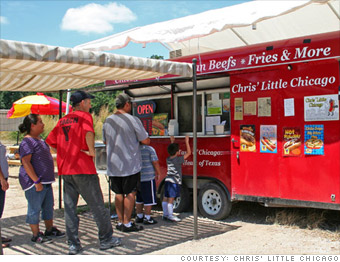
After selling his Illinois gourmet food store and moving to Austin six years ago, Chris Miller was anxious to open another food-related business. So he became an early pioneer of one of food world's hottest trends: mobile food trucks.

Miller's hot-dog trailer transplants a Chicago classic down south. "I manage the trailer myself with a small crew, keep a close relationship with all my customers -- many I know by first name --and put out a quality product that people really seem to enjoy," Miller says.

He likes the flexibility mobility brings. "If the location ever seems to peter out, I can always hook it up and move to another spot," Miller says.

Plus, low overhead translates to low prices: "I can feed a family of four for around $20."

Why it works: "These venues feel local and intimate at a time when consumers are looking for ways to feel connected to their communities," says Kit Yarrow, a consumer psychologist and professor at Golden Gate University in San Francisco. Yarrow has been studying the micro-business phenomenon.

Like many mobile businesses, Miller's advertises its specials on Twitter and encourages fans to post pictures on Facebook.

"The Internet has changed our perception of 'place,'" Yarrow says. "Virtual identity is as real as an identity created by a physical location."

For more unusual ways to make money, visit this site.

[Via - CNNMoney.Com]

The Million-Dollar Idea in Everyone: Easy New Ways to Make Money from Your Interests, Insights, and Inventions

IdeaSpotting: How to Find Your Next Great Idea

How to Make Millions with Your Ideas: An Entrepreneur's Guide by Dan S. Kennedy

101 Businesses You Can Start With Less Than One Thousand Dollars: For Stay-at-Home Moms & Dads

Make Your Ideas Mean Business

Link of the day - If You Sell Links On Your Site, I Will Buy Them Off You

Kamis, 29 Juli 2010

Sauceaholic

Link of the day - If You Sell Links On Your Site, I Will Buy Them Off You

http://www.sauceaholic.com

The barbecue sauces, salsas, mustards and rubs are on the shelves. Now the owners of Sauceaholics just have to hope for business.

They opened the small shop in Lakewood last week. It's a simple operation by most business standards - one employee and 900 square feet of jars and bottles for sale in a shopping center. But they still face the same obstacles every new business does.

The U.S. Small Business Administration reports that about 650,000 businesses opened and another 575,000 closed each year from 2004 to 2008, the most recent data available.

The biggest problem facing most new businesses is lack of access to capital, said Janice Donaldson, regional director of the Small Business Development Center at the University of North Florida.

"Some people have all the money they need and good for them," she said. "But most of the clients we deal with have to borrow money from conventional banks. But that's dried up."

The investment in Sauceaholics has been modest.

The three partners - Don Smith, Sandra Hazen and Jack Gibney - have invested $7,500 each so far. How much will that rise to down the road?

"I'd say $10,000," Smith said. Then he paused and added, "No, make that $12,000."

They didn't have to borrow any of it. But they signed a 16-month lease at $1,900 a month, so they're committed.

"We're flying by the seat of our pants," Smith said.

The idea started last Christmas when Smith went online to buy salsas for his partner in their CPA firm.

"The further I went, the more this exploded," he said. "There's a whole cult out there of people and their salsas."

He ordered a bunch, put together a couple of gift baskets, but it continued to stay in his mind.

"A $30 order might cost $15 in shipping," he said. "So wouldn't it be nice to have a store that had all that salsa? And then it grew into sauces, marmalades, hot sauces. And you talk about a cult, look at hot sauces."

He talked to his wife about it. She talked to Sandra Hazen, a longtime friend, about it. Smith talked to a neighbor, Jack Gibney, about it. And they decided to go for it.

The process was simple: Search the Internet for makers of the products, e-mail them and ask about wholesale prices.

They created a corporation, got a credit card and started ordering. They order mostly in cases of 12, with most costing them $80-$150.

"Our competition," he said, "is who we just bought it from."

Generally, he prices the items a little higher than the manufacturer's retail price and generally a little more than twice what they paid, but there's no shipping. Prices run $3-$10.

"We didn't want to be that sauce place that opened up but their prices are way too high," he said.

A bigger problem with specialty retail shops, Donaldson said, is the obvious one: They compete with the big stores.

"There's a lot of sauces in Publix," Donaldson said. "The same is true with wine shops or anything else you can get at the big boxes. Specialty shops may think they have an advantage, and maybe their sauces taste better than anything anywhere else. But how do you communicate that with the customers?"

Sauceaholics has about 200 different products, and Smith said if they find out a grocery store carries it, they probably won't.

"We can't compete with them," he said.

The trio didn't talk to any small business experts, didn't seek out any advice. And they don't have retail experience.

But Smith is a CPA who has seen the books for lots of small business. Both he and Gibney, an attorney, run their businesses and Hazen owns a bed and breakfast in Vermont.

So they know about rent and overhead.

"If you haven't worked retail," Donaldson said, "it's a grueling experience. Most people who start up don't have a lot of money. So they work it, and their relatives work it. That's why a lot of people quit, because it just isn't as fun as they thought it'd be."

The sauce partners brought in Hazen's son Stephen to run it. He didn't invest but will get a share of the business in return. He staffs it during the week, the owners work on weekends.

The trio don't have a complex business model. Smith figured out the basics of overhead and markups. He figures that they need to sell about $7,000 worth a month before they start making money.

But they haven't figured out a point where they might pull the plug on it if it doesn't go well.

"It depends on where we think we are in the evolution of the company," Smith said. "If we can't think of any new things to try, if we think we've got the best products we can have there, then it might be time.

"The upside is that this is successful and we could open more stores, and that's far, far greater than the downside. I didn't have to mortgage my house. I'd take a hit, but it won't change my lifestyle."

"The downside," Smith said, "is, yeah, we've lost some money. But we've got everyone's Christmas present for the next year or two."

For more unusual ways to make money, visit this site.

[Via - CNNMoney.Com]

The Million-Dollar Idea in Everyone: Easy New Ways to Make Money from Your Interests, Insights, and Inventions

IdeaSpotting: How to Find Your Next Great Idea

How to Make Millions with Your Ideas: An Entrepreneur's Guide by Dan S. Kennedy

101 Businesses You Can Start With Less Than One Thousand Dollars: For Stay-at-Home Moms & Dads

Make Your Ideas Mean Business

Link of the day - If You Sell Links On Your Site, I Will Buy Them Off You

Rabu, 28 Juli 2010

Just Us Hens - Meet The Chickensitters

Link of the day - If You Sell Links On Your Site, I Will Buy Them Off You


http://justushens.com/

PORTLAND, Ore. (CNNMoney.com) -- You've heard of cat-sitters, dog-sitters and, of course, babysitters. But chicken-sitters?

In Portland, Ore., a city known for its deep do-it-yourself streak and poultry-permissive laws, two backyard farmers have stepped up to meet an unusual need: watching hens when their owners go on vacation.

In May, Rhonda Piasecki, 43, and Sharon Rowland, 35, launched Just Us Hens, which they believe is the nation's first chicken-sitting service. The business partners, who each boast a full roost of laying hens (four for Piasenki; eight for Rowland), met last year working at Portland's Urban Farm Store.

"At the store, you'd just talk people's ears off about chickens," says Piasecki, who is also a drummer for Klickitat, a local jazz-rock band.

But the seed the store sells started to aggravate Piasecki's asthma, right around the same time that Rowland decided she wanted to spend more time with her 3-year-old, chicken-loving son Sterling. A friend suggested that Piasecki become a "chicken consultant," while Rowland's husband floated the idea of seeking out hen-sitting gigs.

So the women teamed up to offer a slate of services: $15 per visit for hen sitting, $25 for hen health house calls and $50 an hour for consultations on urban agriculture. In late May, they launched a blog, followed by a full website in early July. They also publicized their services at Portland's online chicken chat group, PDXBackyardChix, which has more than 1,000 members.

The fledgling company has only a handful of customers. But as word passes through Portland's substantial population of urban hen keepers, they hope Just Us Hens will take off.

There's certainly an audience for it. Chickens are all the rage in Portland, where longstanding city regulations allow residents to keep up to three of them -- but no roosters -- without a permit. Even Mayor Sam Adams has a brood: three hens, all named Alma. (Adams let his chief of staff's daughter, Alma, pick the names.) Hundreds of chicken enthusiasts will turn out on Saturday for Portland's seventh annual Tour de Coops, a self-guided stroll through 25 backyard hen houses, including the mayor's own.

One of Just Us Hens' first customers was Renee Wrede, a nurse in Southwest Portland who worried about what would become of her new flock when she and her family took a beach vacation. Rowland signed on to watch "the girls": two barred Plymouth Rock hens, one Ameraucana, one Blue Laced Red Wyandotte and one Welsumer.

During daily visits, Rowland fussed over Poppy, Hyacinth and the other chickens, holding and petting each one. After she fed and watered them, she emailed Wrede to report on how the birds were faring in her absence.

Wrede was thrilled and says the service exceeded her expectations.

"We do have a house-sitter, but she has no idea about chickens," Wrede explains. Rowland, on the other hand, was hard-working expert: "She even scooped the poop!"

The proprietors of Just Us Hens pride themselves on creative problem-solving. "We welcome weird situations," Rowland says.

Piasecki has developed a homegrown solution for a common poultry problem: hens plucking their own feathers. She located a chicken-loving seamstress in Arkansas, who she claims is the nation's best source for chicken aprons. The aprons run $7.50 apiece and can be draped over the chickens' problem areas. "They fit perfectly!" she says.

Just Us Hens isn't the only chicken-related business to take flight in recent years. Katy Skinner, of Yacolt, Wash., runs The City Chicken, an online clearinghouse of chicken-keeping wisdom.

She's seen entrepreneurs make money selling prefabricated coops or coop blueprints, as well as giving classes and lectures. But hen-sitting? Even for a seasoned chicken guru, that's something new.

"This is the first I've heard of a hen-sitting service," she says. "I hope they get a lot of business!"

For more unusual ways to make money, visit this site.

[Via - CNNMoney.Com]

The Million-Dollar Idea in Everyone: Easy New Ways to Make Money from Your Interests, Insights, and Inventions

IdeaSpotting: How to Find Your Next Great Idea

How to Make Millions with Your Ideas: An Entrepreneur's Guide by Dan S. Kennedy

101 Businesses You Can Start With Less Than One Thousand Dollars: For Stay-at-Home Moms & Dads

Make Your Ideas Mean Business

Link of the day - If You Sell Links On Your Site, I Will Buy Them Off You

Selasa, 27 Juli 2010

The Butch Bakery - Boozy, Manly, Camouflage-Frosted Cupcake

Link of the day - If You Sell Links On Your Site, I Will Buy Them Off You


http://www.butchbakery.com/

Entrepreneur: David Arrick, laid-off commercial real estate attorney and former celebrity trainer, now founder of Butch Bakery, an online Manhattan cupcakery

Idea: Cupcakes for men. "We stay away from pastels and sprinkles," Arrick says. Hence the "Driller," a maple cupcake smothered with crumbled bacon and chocolate ganache; the "B-52," a Kahlua-soaked cupcake sporting a camouflage topping and the "Beer Run," a chocolate-beer cupcake with beer-infused buttercream and crushed pretzel sprinkles. Can't decide? The "Butch Box" holds all 12 flavors for $48, plus $8 delivery.

"Aha" Moment: Walking past the long line of people waiting for frilly cupcakes at Magnolia Bakery in Manhattan, the cupcake craze's ground zero. Two thoughts ran through Arrick's head: "I gotta get on that bandwagon" and "Where's the boy bakery?"

StartUp: Arrick cashed out his 401(k) and ran up credit cards to the tune of $25,000. He worked with bakers and consultants to create recipes and focused on building a strong online presence. "It's the biggest risk I've ever taken, but I've reached an age where the worst that could happen doesn't sound that scary."

Payoff: Original sales projection: $5,000 a month. By year's end, the bakery should net more than $10,000 a month. "I think it's OK to say that we're on the other side of the ‘Why didn't I think of that?' fence."

Customers: 90 percent women. "I've tapped into the ‘What do you get for a guy?' market."

Work philosophy: "It's just cupcakes. Relax."

Media Love: A cupcake cookbook deal with John Wiley & Sons, slated for release next year, with 50 "guy friendly" (read: easy) recipes for manly occasions (football season, barbecues, spring training…). On deck: A reality show pilot with MY-Tupelo Entertainment. The concept: "Guy reinvents himself through a bakery."

2011 and Beyond: Develop a masculine baking brand, start shipping nationwide, open Butch Bakeries in Chicago, Boston, L.A., San Francisco and Miami; ultimately, "I'll be a cross between Rachael Ray and Guy Fieri."

For more unusual ways to make money, visit this site.

[Via - Entrepreneur]

The Million-Dollar Idea in Everyone: Easy New Ways to Make Money from Your Interests, Insights, and Inventions

IdeaSpotting: How to Find Your Next Great Idea

How to Make Millions with Your Ideas: An Entrepreneur's Guide by Dan S. Kennedy

101 Businesses You Can Start With Less Than One Thousand Dollars: For Stay-at-Home Moms & Dads

Make Your Ideas Mean Business

Link of the day - If You Sell Links On Your Site, I Will Buy Them Off You